Finding Bosede
Part Two: The Disapearance of Bosede

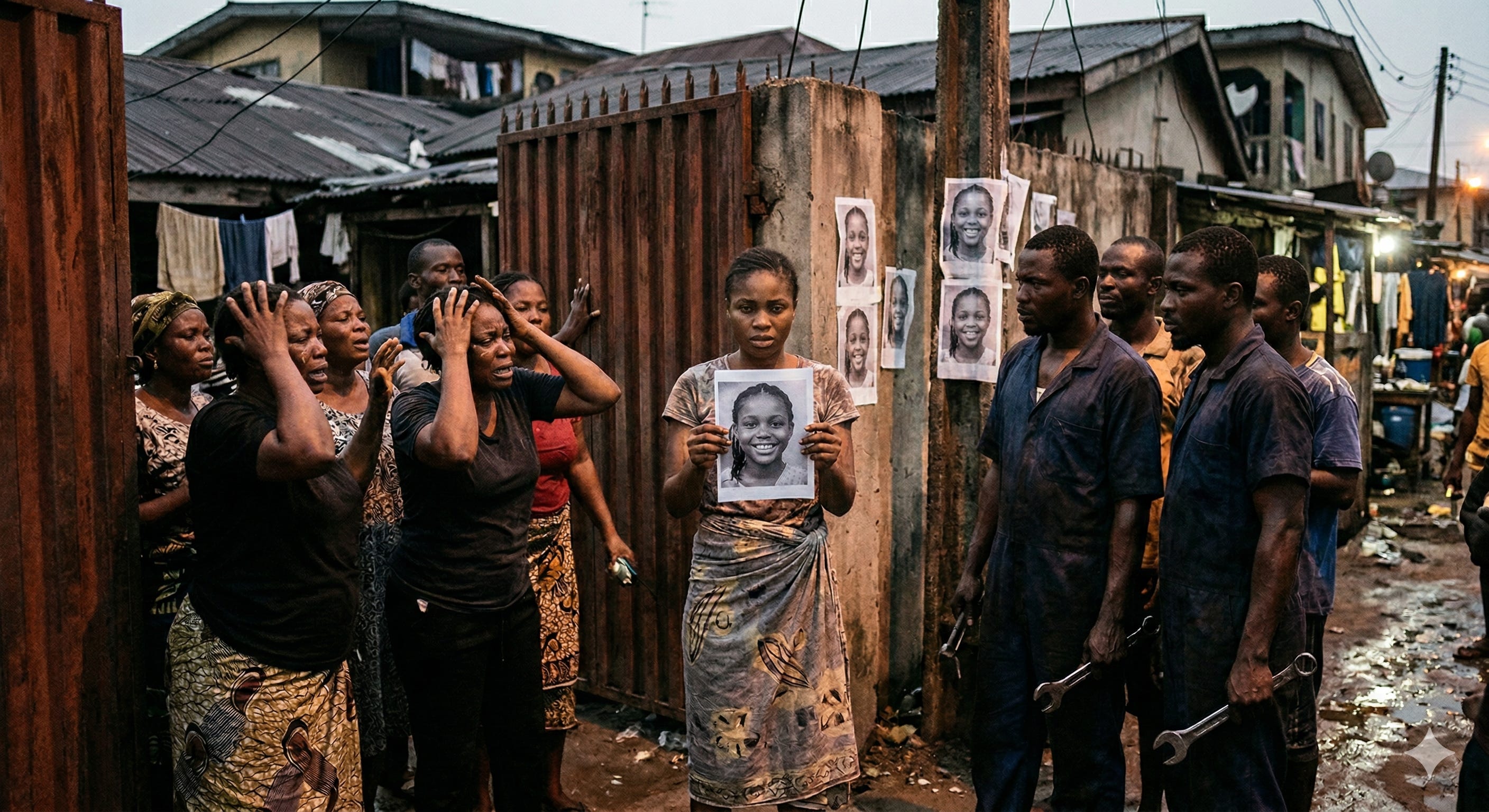
Obalende clings to its people the way old Ankara cloth holds its stubborn dye.
It holds them tightly. It holds them fiercely. It holds them even when the very edges of the neighborhood are fraying into dust.
Chika lives in a crowded face me I face you compound just off a narrow lane near Moloney Street. Entire families squeeze into three cramped rooms. The rusted zinc roofing amplifies every single rainstorm into a deafening percussion concert. The compound alone holds fourteen children. The oldest is a quiet seventeen-year-old boy. The youngest is a toddler who just learned to walk. He falls constantly, and he laughs every single time his bare knees hit the dirt.
Bosede is thirteen.
Was thirteen.
The terrible news arrives on a Wednesday evening. It travels street by street in the mouths of frantic women who press their palms flat against their heads when they speak. Bosede left her classroom at exactly half past two in the afternoon. Two classmates spotted her at the busy junction near the BRT bus stop. She wore her crisp school uniform. It was a navy blue pinafore paired with a bright white collar. Her canvas school bag was slung over one shoulder.
Then there was absolutely nothing.
The young girl ceases to exist in the physical world.
Her mother is Mama Bosede. She sells hot ogi from a large pot at the corner of the lane. Mama Bosede does not sleep at all that night, and she refuses to eat a single bite of food. She goes directly to the Onikan police station on Thursday morning wearing her very best Sunday dress. She believes a good dress commands respect from men in uniform.
The police officer at the wooden counter does not even look up from his mobile phone for four agonizing minutes. When he finally raises his head, he writes absolutely nothing down. He tells her that children run away sometimes. He tells her the girl will definitely return when she gets hungry enough.
He says this with the flat, dead confidence of a man who has never loved anything that could be taken away from him.
Mama Bosede returns home with empty hands.
The entire lane erupts into chaos.
Women who have not spoken to each other in months stand shoulder to shoulder at the rusted compound gate. The mechanics from the workshop three streets over arrive with heavy metal tools still clutched in their grease-stained hands. They do not bring the tools to fix anything. They bring them because they desperately need to hold something solid. Someone prints a faded photograph of Bosede from an old Facebook post. It is a simple class photo where the young girl is smiling widely with one missing tooth. The photograph is taped desperately to every single wooden pole on the street.
The police never come.
The police are somewhere else. They are managing something they deem far more important than a poor girl who has dissolved completely from the surface of the earth.
Chika stands quietly at the edge of the noisy lane. She holds the printed photograph carefully in both hands, and she stares at the smiling face for a very long time.
She knows this specific face.
The memory sparks violently in her mind. She knows exactly where she has seen those terrified eyes before.